What is Oprela Manufacturing: From Customer File to Finished Product in One System
Oprela Manufacturing guides a product from customer request and 3D model through specification, routing, nesting, and the shop floor to quality control. We explain the problem it solves and what the order journey looks like.
In most custom manufacturing operations, product information is rewritten at least five times. The manager calculates the price in a spreadsheet. The designer creates a model in CAD. The technologist manually transfers details to the specification. The planner schedules on a whiteboard or in another spreadsheet. The foreman assigns work verbally. Each rewrite introduces new errors, and no one knows exactly how much an order cost until the end of the month.
Oprela Manufacturing is a single system through which a product progresses from the initial customer request to the finished product. The model, price, specification, routing, nesting, shop floor work, and quality control all rely on the same data.
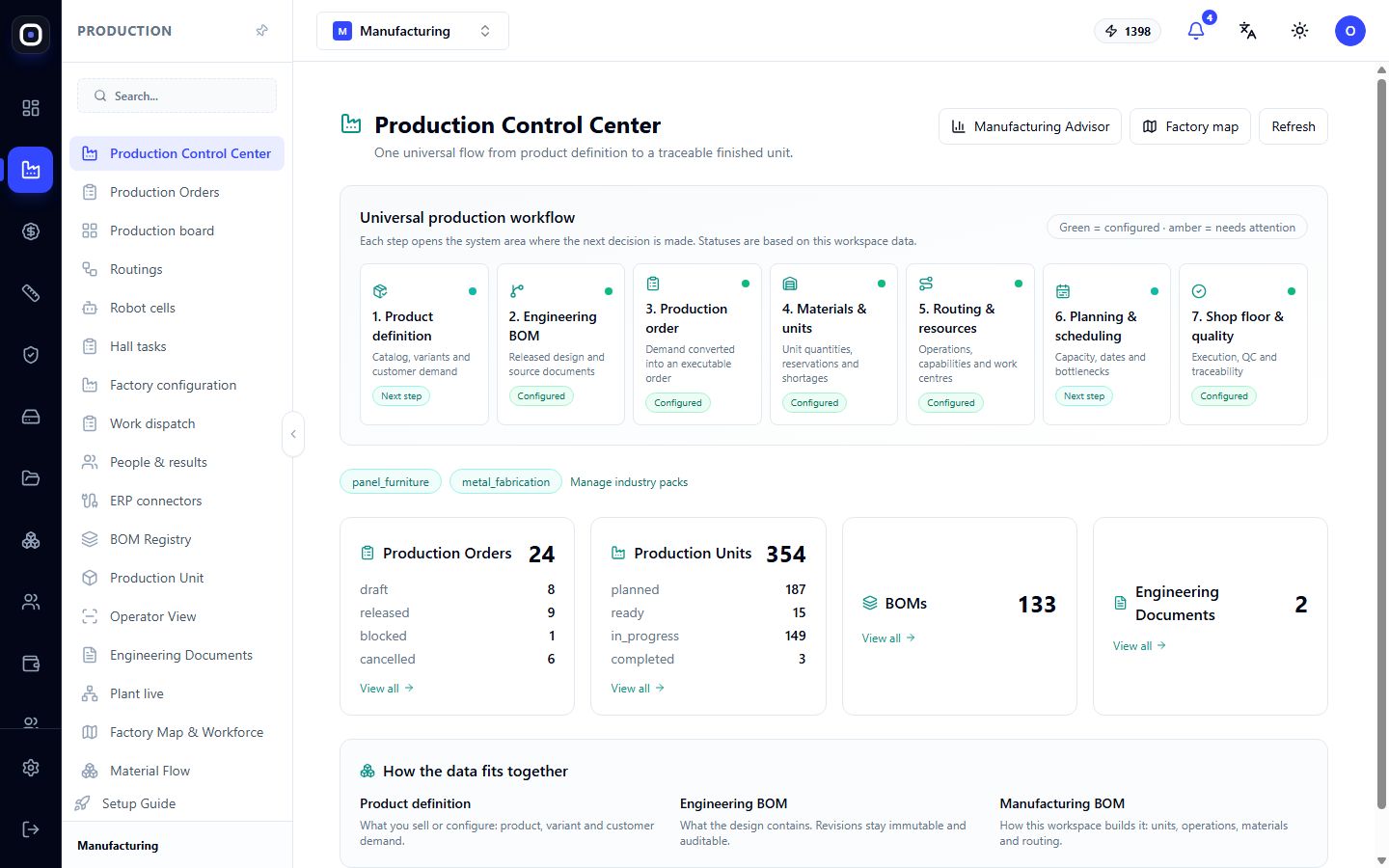
The Journey of a Single Order
1. Request and Quote. The customer sends a photo, sketch, or 3D model. The system estimates the cost based on your material prices, machines, and rates, and the manager sends the customer a proposal with a 3D preview via a link.
2. Engineering. The STEP model from the designer is automatically broken down into assemblies and parts: quantities, materials, profiles, sheet metal parts. This forms the Bill of Materials (BOM), and manufacturing drawings and flat patterns are generated from the model.
3. Technology. Each type of part follows its own route: cutting, bending, drilling, welding, painting, assembly. The time for each operation is calculated from the part's geometry and the capabilities of the specific machine.
4. Planning. The order is broken down into production units. The system plans sheet and tube nesting, checks material in stock, and schedules operations based on machine and personnel capacity.
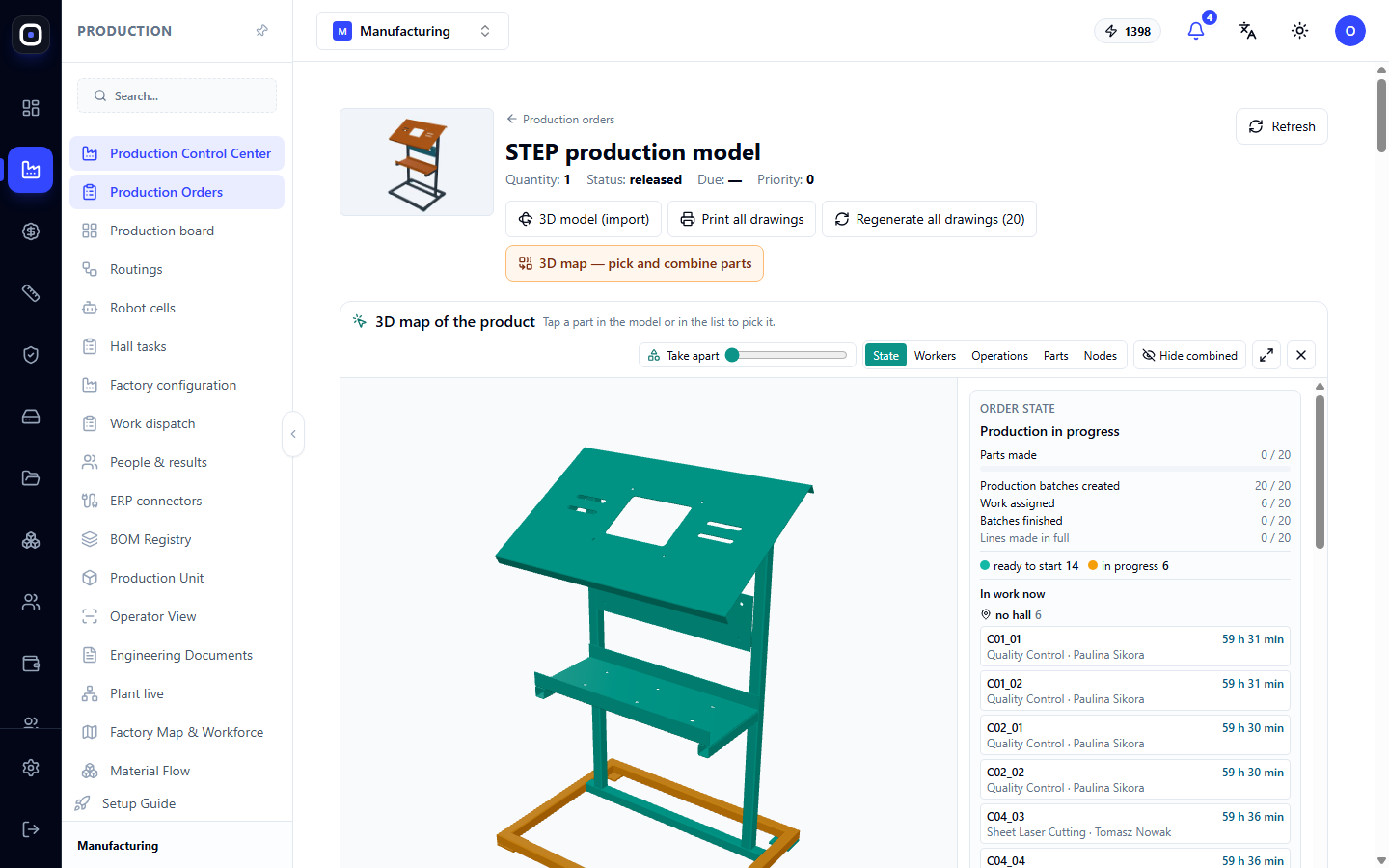
5. Shop Floor. The foreman sees the order on a 3D product map and distributes work. The worker receives tasks on a kiosk or phone, scans the part, and marks completion. The application works even without internet.
6. Quality and Results. Inspections, defects, non-conformities, rework, and scrap are recorded for each unit. The manager sees actual time and cost and compares them to the estimate.
What Changes for the Factory
- A price you can trust. The estimate is based on your real prices, machines, and human pace, and after order completion, it's compared to actuals.
- One truth about the product. The model, specification, drawings, and route are linked. If the model changes, it's clear what needs to be rebuilt.
- Paperless shop floor. The worker sees their task, drawing, and 3D, and the foreman sees the status of each part in real-time.
- Traceability. For each unit, it's known who, when, on which machine, and from what material it was made.
- Manageability. The owner sees workload, delays, and their causes, instead of learning about them from the customer.
What's Inside
- Sales and Pricing: customer requests, quick photo-based estimation, Costing Studio, Factory Calculator, Manufacturing Advisor, customer proposals, public studio for self-design.
- Engineering: 3D STEP import, drawing recognition, product family configurator, kitchen designer, BOM (Bill of Materials) register, manufacturing drawings.
- Technology: routes and route editor, sheet and tube nesting, bending center, robotic welding cells, blending and packaging.
- Planning: production orders, production board with Gantt chart, APS (Advanced Planning and Scheduling), material flow.
- Shop Floor: foreman's dashboard, work distribution, shop tasks, operator workstation, Oprela Floor application.
- Control: live factory, production map, quality management, people and results.
AI as an Assistant, Not a "Black Box"
The AI assistant reads photos and drawings, suggests designs, explains costs, and advises where to save money. Decisions affecting money and production remain with the human: the assistant prepares, the human approves. More details – AI Assistant in Manufacturing.
Who Is It For
Oprela Manufacturing is designed for custom and small-batch production: metal structures, furniture, commercial equipment, sheet and tube products. For details – Who Oprela Manufacturing Is For.