How Oprela Calculates Operation Time: Geometry, Machine, and Human
Operation time in Oprela is not manually entered for each part. It's calculated based on the part's shape, the specific machine's capabilities, and the worker's pace, then refined with actual data. We explain the model in simple terms.
Time standards are the foundation of both pricing and planning. If a standard is incorrect, everything else is incorrect: the customer offer, workshop load, deadline, and employee bonus. At the same time, manually entering a standard for each new part in make-to-order production is impossible: parts are always different.
Oprela calculates time from three components.
1. What needs to be done: part geometry
From the 3D model, the system knows everything about the part that affects time:
- cutting — contour length, number of holes, thickness, and material;
- bending — number of bends, length, and part size;
- welding — length of seams and their type;
- drilling, milling, assembly — number of elements and dimensions.
2. How it's done: machine profile
Each machine has its own numbers: cutting speed for material and thickness, time per bend, setup time, welding speed. For typical machines, there are templates that you supplement with your own values. Two identical machines can have different profiles if they operate differently.
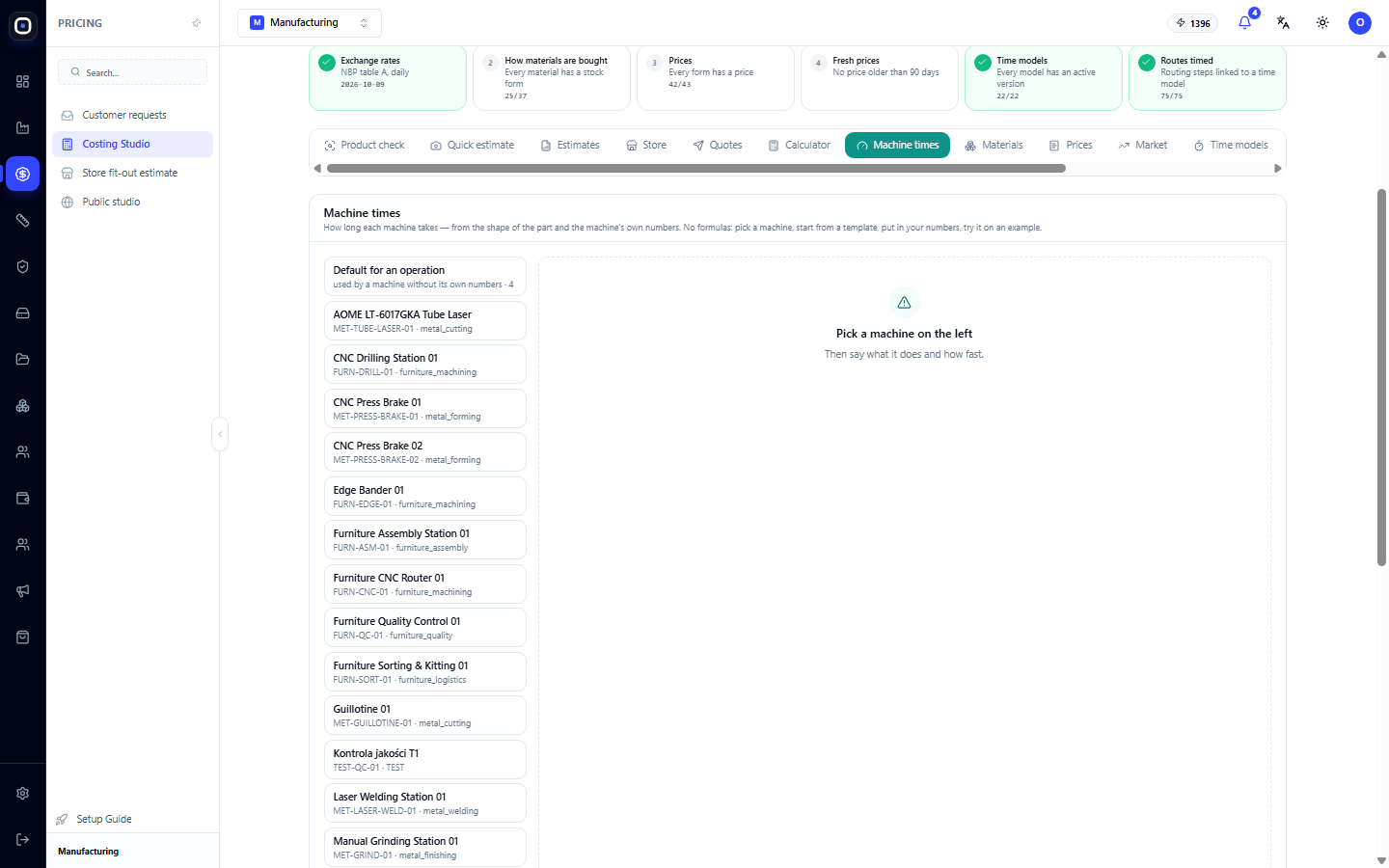
Calculated separately are:
- setup — once per batch, regardless of quantity;
- time per piece — multiplied by quantity.
Therefore, the price per piece for a batch of one hundred units is justifiably lower than for a single one.
3. Who does it: human pace
An experienced welder and a novice work at different speeds. The system takes into account the worker's qualification and pace, so the plan for a section where novices work will not be unrealistically optimistic.
How it's verified
A calculation is a hypothesis. The actual data comes from the shop floor: the worker marks the start and completion of an operation in Oprela Floor. The system compares the calculated time with the actual time, and if the difference is stable, the Manufacturing Advisor suggests calibration: for example, "welding on this machine takes, on average, 25% longer than calculated." The technologist reviews the suggestion and accepts or rejects it. Nothing changes without human intervention.
Where the calculated time is used
- Price: machine and human labor in the cost of goods.
- Planning: machine and section load, deadlines.
- Work distribution: the foreman sees how long an operation should take, and the system signals when it's taking too long.
- People's results: productivity is compared against a realistic standard.
Why this is better than "experience-based" standards
- A new part gets a standard immediately, without time studies.
- Standards are consistent for all technologists and managers.
- Changing a machine or technology changes standards for all parts simultaneously.
- Standards become more accurate with each completed order.
How to get started
Set up profiles for 3–5 machines that account for the largest share of time (usually cutting, bending, welding). Verify the calculation on a few parts whose times you know well. Add the remaining machines gradually.